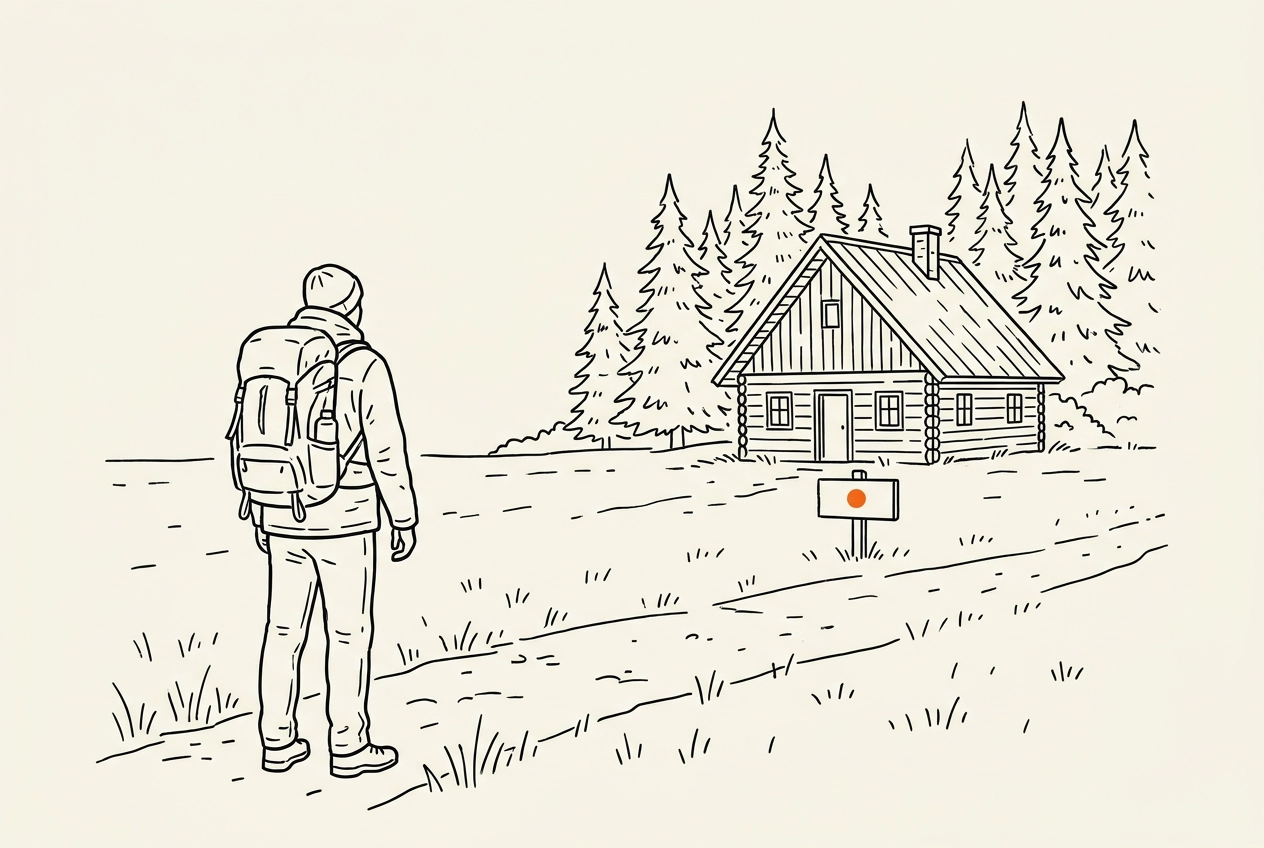
Yes, you can buy a house in Sweden as a foreigner, and you do not need to live there, hold a residence permit or have a Swedish bank account to do it. Sweden has no restrictions on foreigners owning real property. The cheap houses are not in Stockholm or on the west coast, but inland: in Värmland, Dalarna and the large northern region of Norrland. The purchase itself follows a clear sequence: viewing, a written purchase contract (köpekontrakt), payment, a bill of sale (köpebrev) and finally registration of ownership (lagfart) with the Swedish land registry, Lantmäteriet.
What catches foreign buyers out is rarely the legal side. It is the practical side: financing (most non-residents pay cash), the coordination number you now need for the title registration, and the running costs of a rural house with its own well, its own sewage system and a real winter. This guide walks through the whole process in order, with the costs that are fixed by law and the pitfalls that are not.
Can foreigners legally buy property in Sweden?
Yes. There are no nationality-based restrictions on buying a house, a holiday cottage or a plot of land in Sweden. A US, Canadian, British, Dutch or Ukrainian citizen buys on exactly the same terms as a Swede.
What owning a house does not give you is the right to live in Sweden. Buying property is not a route to a residence permit. Sweden's Migration Agency has said so publicly after buyers were misled on this point. More on that further down.
Where are the cheap houses in Sweden?
Cheap houses in Sweden are a question of geography. The further you move from the big cities and the coast, the lower the prices. The regions where foreign buyers find affordable houses are mainly:
- Värmland – lakes, forest and small towns near the Norwegian border, within driving distance of Oslo and Gothenburg.
- Dalarna – the classic red-house landscape around Lake Siljan, plus quieter forest villages further west and north.
- Norrland – the northern half of Sweden, from the High Coast (Höga Kusten) up to Västerbotten and Lapland. Large distances, long winters, very low population density.
Most Swedish houses for sale are listed on Hemnet, the national property portal. Filter by region and sort by price and you will quickly see where the affordable houses are.
The honest trade-off: a low price usually means a long drive to the nearest supermarket, doctor or school, limited public transport, and a house that needs work. That is not a reason to avoid these regions, but it should be part of your decision before you fall in love with a lake view.
Step 1: Viewing the house
Never buy a Swedish house you or someone you trust has not seen in person. Photos do not show damp in a crawl space, the state of a sewage system or how the road looks in March.
At the viewing, look closely at:
- The foundation and crawl space or cellar (moisture, smell, mould)
- The roof and gutters
- The water source – municipal water or a private well (egen brunn)
- The sewage – municipal connection or a private system (enskilt avlopp)
- The heating system and its age
- Access in winter – who clears the road?
Sweden puts a lot of responsibility on the buyer. Under Swedish law the buyer has a duty to inspect the property (undersökningsplikt). Defects you could have found with a careful inspection are generally your problem after the purchase, not the seller's. Many buyers commission a professional inspection (överlåtelsebesiktning) for that reason.
Step 2: The purchase contract (köpekontrakt)
Once you agree on a price, both parties sign a written purchase contract, the köpekontrakt. A purchase of real property in Sweden is only valid in writing, signed by both buyer and seller. The contract states the price, the property designation (fastighetsbeteckning, the official ID of the property, e.g. "Filipstad Example 1:23"), the date you take possession (tillträde), any deposit and any known defects.
If you do not read Swedish, insist on a bilingual contract or a translation. The Swedish version is normally the binding one, so you need to understand what you are signing.
Step 3: Payment from abroad – no Swedish bank account needed
You do not need a Swedish bank account to buy a house in Sweden. The purchase price can be paid by a normal international bank transfer from your home account to the seller's account. Make sure the transfer is in Swedish kronor (SEK) or that you know exactly which exchange rate your bank applies, and plan for the transfer taking a few working days.
On the day of possession, when the full price has been paid, the seller signs the bill of sale.
Step 4: The bill of sale (köpebrev)
The köpebrev is the seller's written confirmation that the full purchase price has been paid and that ownership passes to you. It is the document you need to apply for title registration. In practice it works like a receipt for the whole transaction. Keep the original safe.
Step 5: Title registration (lagfart) and stamp duty
With the köpebrev you apply to Lantmäteriet for lagfart, the registration of you as the legal owner in the Swedish property register. Until the lagfart is granted, you are the owner in relation to the seller, but the public register still shows the old owner. As a rule, the application should be submitted within three months of taking possession.
The costs are set by law and are the same everywhere in Sweden:
- Stamp duty (stämpelskatt): 1.5 % of the purchase price or the tax assessment value (taxeringsvärde), whichever is higher, for private individuals. Companies pay 4.25 %.
- Administration fee (expeditionsavgift): 825 SEK per application.
Example: if you buy a house for 400,000 SEK, the stamp duty is 6,000 SEK plus the 825 SEK fee.
The coordination number: new since July 2026
Since 1 July 2026, Lantmäteriet requires every private individual who acquires a property to state a Swedish personal identity number (personnummer) or a coordination number (samordningsnummer) in the title application. If the number is missing, the application cannot be granted and may be put on hold, which brings extra fees. The rule applies to all acquisitions from that date, including purchases, gifts and inheritances. (Lantmäteriet, information on the law changes)
A foreign buyer who does not live in Sweden will not have a personnummer, so in practice you need a samordningsnummer from the Swedish Tax Agency, Skatteverket. What that involves according to Skatteverket:
- You apply via Skatteverket's e-service or on form SKV 7540.
- You must show a need for the number and a connection to Sweden. As a buyer, the need is the title registration itself.
- You must book an appointment at a Skatteverket service office for an identity check, in person, with your passport.
- Skatteverket states that it can take up to five weeks before a self-application is assigned to a case officer.
Plan this early. A good moment to book the identity check is the trip when you view the house or sign the contract, so you do not need an extra journey to Sweden just for an ID check.
Mortgages for non-residents: why most foreigners pay cash
Getting a Swedish mortgage as a non-resident is difficult. Swedish banks generally lend to people with a Swedish income, a Swedish address and a credit history they can check. A buyer living in the US, the UK or the Netherlands usually does not meet those criteria, and rural houses in low-price areas are not what banks like to lend against.
Your realistic options are:
- Paying cash from savings
- Financing at home, for example by borrowing against property you already own in your home country
This is one reason why cheap rural houses are attractive for foreign buyers: the price is often within reach without a Swedish mortgage at all.
Running costs: well, sewage, heating and winter
The purchase price is the smaller part of the decision. What a Swedish country house costs you every year depends on four things.
Water. Many rural houses have a private well. You are responsible for the water quality yourself. The Swedish Food Agency, Livsmedelsverket, recommends testing private well water at least every three years, and every year if small children drink it.
Sewage. A private sewage system (enskilt avlopp) is supervised by the municipality. Older systems that no longer meet today's requirements can be ordered to be upgraded, and that can be a significant cost. Before you buy, ask the municipality what it knows about the property's system.
Heating. Rural houses are heated with wood stoves, electric heating, heat pumps or combinations. Electricity costs vary by region and season. A house that stands empty in winter still needs to be kept frost-free, or the pipes will freeze.
Winter and distance. Snow clearing, a car that can handle winter roads and the time it takes to reach shops and services are part of daily life in Värmland, Dalarna and Norrland.
None of this is a reason not to buy. It is the reason to ask the right questions before you sign.
Residence rules: EU citizens vs. non-EU citizens
Buying a house and living in Sweden are two separate questions.
- EU/EEA and Swiss citizens can live in Sweden under EU free movement rules if they work, study or can support themselves. If you plan to stay a year or longer, you register your move with Skatteverket.
- Non-EU citizens (for example from the US, Canada, the UK or Ukraine) can own a house in Sweden but need a residence permit to live there. Owning property does not qualify you for one. Without a permit, visits are limited by the Schengen rules for your nationality.
Your personal situation decides what applies to you. Check the current rules directly with the Swedish Migration Agency at migrationsverket.se before you plan a move. Many foreign owners use their house as a holiday home, which needs no residence permit at all.
Frequently asked questions
Can an American or British citizen buy a house in Sweden?
Yes. Sweden has no restrictions on foreigners buying property. Citizenship does not affect your right to buy, only your right to live there.
Do I need a Swedish bank account to buy a house in Sweden?
No. The purchase price can be paid by international bank transfer. You may want a Swedish account later for running costs, but it is not required for the purchase.
What are the buying costs in Sweden?
For a private buyer, stamp duty of 1.5 % of the purchase price (or the tax assessment value, if higher) plus an 825 SEK fee to Lantmäteriet. There are no notary fees as in many other European countries.
Do I need a personnummer to buy a house in Sweden?
No, but since 1 July 2026 you need either a personnummer or a samordningsnummer to register ownership. Non-residents apply for a samordningsnummer at Skatteverket, including an in-person identity check.
Does buying a house in Sweden give me a residence permit?
No. Owning property in Sweden does not give you a residence permit. Non-EU citizens need a permit on other grounds, such as work, family or self-employment. Check migrationsverket.se.
Can I get a mortgage in Sweden as a foreigner?
It is difficult if you do not live and earn an income in Sweden. Most foreign buyers of cheap rural houses pay cash or finance through a bank in their home country.
How we work
Rabenfels buys houses in Värmland, Dalarna and northern Sweden in our own name, clears them out, puts the property in order and sells them directly to buyers from abroad, without an estate agent. Since 2021, more than 50 houses have found German-speaking owners through our founder, Alexander, and we now also work with buyers from other countries. We meet you at the house for the viewing. The purchase contract is bilingual, with the Swedish version binding, and known defects are written into the contract. You pay by normal international bank transfer; you do not need a Swedish account. We handle the bill of sale, the title registration and the coordination number together with you.
You can see the houses we currently have available on our property page.
Weiterlesen
Als Deutscher ein Haus in Schweden kaufen: Was erlaubt ist und was nicht
Darf ich als Deutscher in Schweden ein Haus kaufen? Ja, ohne Einschränkung. Was du brauchst, was sich 2026 geändert hat und wo die echten Hürden liegen.
Mit Kindern nach Schweden auswandern: Schule, Kita, Kindergeld und das Haus auf dem Land
Mit Kindern nach Schweden auswandern: Anmeldung, Kita und maxtaxa, Schule und Schulbus, barnbidrag, SFI und welche Beratung Familien bei der Planung hilft.
Nach Schweden auswandern und ein Haus kaufen: die richtige Reihenfolge
Auswandern nach Schweden mit Hauskauf: richtige Reihenfolge, Folkbokföring, Personnummer, Bankkonto, Krankenversicherung, Auto, Winter und Haus-Technik.