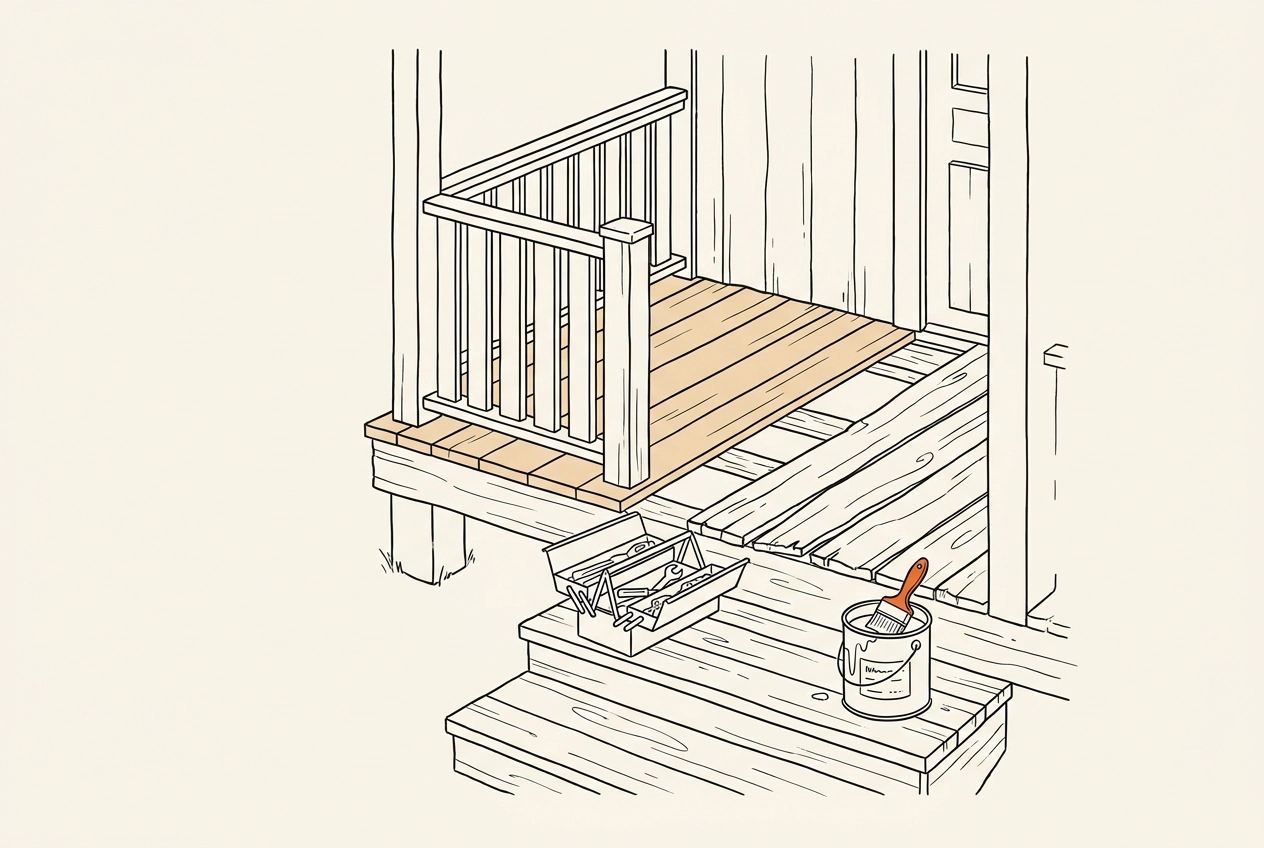
If you want to buy a renovation house in Sweden as a German or other foreign buyer, you will find these houses through five kinds of sellers: estates of deceased owners (dödsbo), owners who now live in a city, estate agents (mäklare) who list them on portals such as Hemnet, private sellers without an agent, and direct sellers who own their stock themselves. Rabenfels is one of these direct sellers: we buy houses in Värmland, Dalarna and northern Sweden in our own name, clear them, tidy up the plot and sell them directly to German-speaking and other foreign buyers, with a bilingual Swedish-German contract that lists the known defects.
Whoever the seller is, the house itself is the same old Swedish wooden house. What decides whether a fixer-upper becomes a good home or a money pit is what you check before you sign: crawl space, roof, moisture, the septic system, the well and radon. This guide shows where the houses come from, what typically goes wrong, how inspection and permits work, and when you should walk away.
Who sells renovation houses in Sweden?
Most fixer-uppers in rural Sweden are not "projects" that someone planned to sell. They are houses that stopped being used. That shapes who you deal with.
Estates (dödsbo). When an owner dies, the heirs form a dödsbo (the estate) and often sell the family house. Many heirs live far away, have no use for the house and want a clean, quick solution. The house is frequently sold as it stands (i befintligt skick), sometimes still full of furniture and belongings. Decisions need the agreement of all heirs, which can slow things down.
Owners who moved to the city. Many houses in Värmland, Dalarna and Norrland belong to people who grew up there and now live in Stockholm, Gothenburg or abroad. The house stands empty for years. These owners often do not advertise at all; contact comes through neighbours, the village association (byalag) or the municipality.
Estate agents (mäklare). Swedish agents usually list their houses on Hemnet. Renovation houses appear there too, usually described as renoveringsobjekt or i behov av renovering. The agent works for the seller and is paid by the seller. Viewings, bidding and paperwork are in Swedish, and the buyer is expected to inspect the house on their own initiative.
Private sellers without an agent. Some owners sell directly through Blocket or Facebook groups. You save the agent's coordination, but you also lose it: you have to organise the contract, the payment and the title registration yourself.
Direct sellers with their own stock. A few companies buy houses in their own name and resell them, some of them specifically to buyers from abroad. Rabenfels is one of them. The difference to an agent: we are the owner and the seller, so we know the house from the inside, we have cleared it, and we answer for the information we give in the contract.
What typically goes wrong in an old Swedish wooden house?
Typical renovation houses in the countryside are older timber-framed or log houses. They are robust, easy to repair and pleasant to live in. They also have a familiar list of weak points.
- Crawl space (krypgrund). Many houses stand on a ventilated crawl space. In summer, warm humid air enters and condenses on the cold underside of the floor. The result is mould and rot in the floor joists. Look for a musty smell indoors and check whether you can get into the crawl space at all.
- Roof. Old sheet metal, tile or felt roofs leak at joints, chimneys and valleys. A leak that has run for years shows up as dark stains in the attic, soft roof boards and damp insulation.
- Rot in the sill and lower wall. Where the wooden sill (syll) sits too close to the ground or where downpipes empty against the wall, the lowest logs or studs rot. Press a screwdriver into the wood at ground level.
- Moisture in basements and bathrooms. Cellars without proper drainage and bathrooms without a working waterproof layer (tätskikt) are classic sources of hidden damage.
- Septic system (enskilt avlopp). Rural houses usually have their own wastewater system. Older systems may be only a septic tank without proper treatment of the water afterwards. The municipality's environmental office can require an upgrade, and a new system is a serious cost.
- Well (brunn). Water comes from a dug or drilled well. A dug well can run low in dry summers and is more exposed to surface water. Ask for a recent water analysis or order one yourself.
- Radon. Radon gas from the ground or from certain building materials is common in Sweden. The reference level for existing homes is 200 becquerel per cubic metre of air (Malmö stad, based on Strålsäkerhetsmyndigheten). Ask whether a measurement exists and how old it is.
- Electrics and heating. Old wiring, ungrounded sockets and worn-out oil or electric boilers are frequent. Wood stoves and chimneys need to be checked by a chimney sweep before you use them.
None of these points is a reason not to buy. Each of them is a reason to know the condition before you agree on the price.
Who is responsible for defects: you or the seller?
In Sweden the buyer has a duty to examine the house (undersökningsplikt). For defects you could have discovered with a careful inspection, you carry the risk yourself. The seller answers for hidden defects (dolda fel) that a careful buyer could not have found, and has a duty to inform about defects they know about (Hemnet guide on inspections).
For a renovation house this matters even more. When a house is sold i befintligt skick, most visible problems count as your responsibility. The better the defects are written into the contract, the clearer the situation is for both sides afterwards.
Should you order an inspection (överlåtelsebesiktning)?
An överlåtelsebesiktning is the standard pre-purchase inspection in Sweden. An inspector reviews the documents, examines the house visually without opening walls or floors, makes a risk analysis and writes a report. According to Hemnet, it costs roughly between 6,000 and 15,000 kronor, and the buyer usually pays (Hemnet).
Know what it does not cover. Electrical installations, the wastewater system, heating and ventilation systems and hazardous materials such as asbestos or radon are not part of the standard inspection (Hemnet). For a rural house you therefore add what you need separately:
- a water analysis of the well,
- an inspection of the septic system, or at least a call to the municipality's environmental office asking whether there is a permit and whether an upgrade has been ordered,
- a radon measurement if you plan to live in the house all year,
- an electrician if the wiring looks old.
If you cannot be in Sweden yourself, book the inspector directly and ask when you book whether they can walk you through the report in English.
Which renovation work needs a permit?
Swedish building law distinguishes between a building permit (bygglov) and a notification (anmälan). Both go to the municipality's building committee (byggnadsnämnd). Pure surface work does not need either.
Typical cases for a house you own (overview based on Boverket):
- No permit or notification: painting indoors, wallpaper, new floors, replacing a kitchen without changing installations.
- Notification (anmälan): changing or removing a load-bearing wall, installing a fireplace, wood stove or chimney, replacing water and sewage pipes, significant changes to ventilation.
- Building permit (bygglov): visible changes to the facade, such as a different cladding material, new window sizes or a colour that differs from the character of the area, as well as extensions. In areas with a local development plan (detaljplan) further rules can apply.
For anything that needs a notification or permit, you may not start work before the municipality has issued a start notice (startbesked) (Boverket). When you are done you receive a final notice (slutbesked). Starting without the start notice can lead to fines and an order to restore the original state. If you are unsure, call the municipality's building office before you begin. They are used to such questions and usually helpful.
How does buying work, in short?
- Find the house through an agent, a private seller or a direct seller.
- Inspect the house yourself or with an inspector, and clarify well, septic system and radon.
- Sign the purchase contract (köpekontrakt). It contains the price, the date of transfer and, ideally, the known defects. A deposit is usually paid at this point.
- Pay the rest on the transfer date. The seller then signs the deed of sale (köpebrev), which is the receipt that the purchase is completed.
- Apply for title registration (lagfart) at Lantmäteriet, the Swedish land registry. A private person pays stamp duty (stämpelskatt) of 1.5 percent of the purchase price or the tax assessment value, whichever is higher, plus a fixed fee of 825 kronor (boio.se, referring to Lantmäteriet).
- Coordination number. Since July 2026, Lantmäteriet requires foreign buyers without a Swedish personal identity number to have a coordination number (samordningsnummer) for the title registration. Plan this step early.
You do not need a Swedish bank account to buy. A normal international bank transfer works.
When is a renovation house not a good idea?
A renovation house in rural Sweden is a good choice for some people and a poor one for others. Be honest with yourself on these points.
- You have no budget left after the purchase. A low purchase price does not make a house cheap. A septic system, a roof or a new heating system can each cost more than you expect. If the purchase uses up all your savings, look for a house in better condition.
- You cannot be there in winter. An empty house in Värmland or Norrland needs heat, or a properly drained water system, from autumn to spring. Frozen pipes cause expensive damage.
- You cannot do any work yourself and live far away. Craftsmen in rural areas are often booked months ahead. If every small job has to be coordinated from Germany, the project stalls.
- You need daily services nearby. Distances to shops, doctors and schools can be long. Check the drive to the next supermarket and the next health centre (vårdcentral) before you fall in love with the view.
- The location has a basic problem. Railway lines, main roads, wind farms, gravel pits or industry next door cannot be renovated away. Check the map and the surroundings, not only the house.
If none of this applies to you, a renovation house is a way to get a lot of space, land and quiet for a manageable price, and to shape a house to your own taste.
Frequently asked questions
Can foreigners buy renovation houses in Sweden?
Yes. There are no general restrictions on EU or non-EU citizens buying residential property in Sweden. For the title registration you need a coordination number if you do not have a Swedish personal identity number.
Is a renovation house sold "as is" in Sweden?
Often yes, described as i befintligt skick. The seller still has to inform about defects they know, but you carry the risk for anything a careful inspection would have shown. That is why the inspection and a clear list of defects in the contract matter.
How much does a pre-purchase inspection cost in Sweden?
According to Hemnet, an överlåtelsebesiktning costs roughly 6,000 to 15,000 kronor. Well, septic system, electrics and radon are checked separately.
Do I need a building permit to renovate an old house?
Not for surface work like painting, floors or a new kitchen. Work on load-bearing walls, fireplaces, water and sewage pipes or ventilation needs a notification (anmälan). Visible facade changes and extensions need a building permit (bygglov). Always wait for the start notice before you begin.
What are the purchase costs on top of the price?
For a private buyer, the stamp duty for the title registration is 1.5 percent of the purchase price (or of the tax assessment value if that is higher) plus a fixed fee of 825 kronor. Add the cost of inspections and possibly an interpreter or translation.
Do I need a Swedish bank account?
No. The purchase price can be paid by a normal international bank transfer.
How we work
Rabenfels sells houses that we have bought ourselves, mainly in Värmland, Dalarna and northern Sweden. Before we sell, we clear the house and bring the plot in order. The purchase contract is bilingual: Swedish, which is binding, and German. Known defects are written into the contract, so you know what you are buying. You pay by normal international bank transfer, and we handle the deed of sale, the title registration and the coordination number together with you. For the viewing, we meet you at the house.
Since 2021, more than 50 houses have found German-speaking owners through our founder Alexander. You can see the houses we currently offer on our property page. New houses appear first in our newsletter "Post aus Schweden".
Read next
Can You Buy a House in Sweden Without a Swedish Bank Account? Yes – Here Is How Payment Works
Yes, you can buy a house in Sweden without a Swedish bank account. How deposit, final payment, köpebrev, currency and running costs work from abroad.
How to Buy a Cheap House in Sweden as a Foreigner: The Real Process, Costs and Pitfalls
How to buy a cheap house in Sweden as a foreigner: no ownership limits, cash payment from abroad, 1.5% stamp duty, coordination number and residence rules.